Brian sits down with Doug from Washington State, a lifelong resident of Pend Oreille County in the far northeastern corner of the state, for a conversation that starts with one winter night on a county road and opens out into thirty years of reports from the same block of mountains.
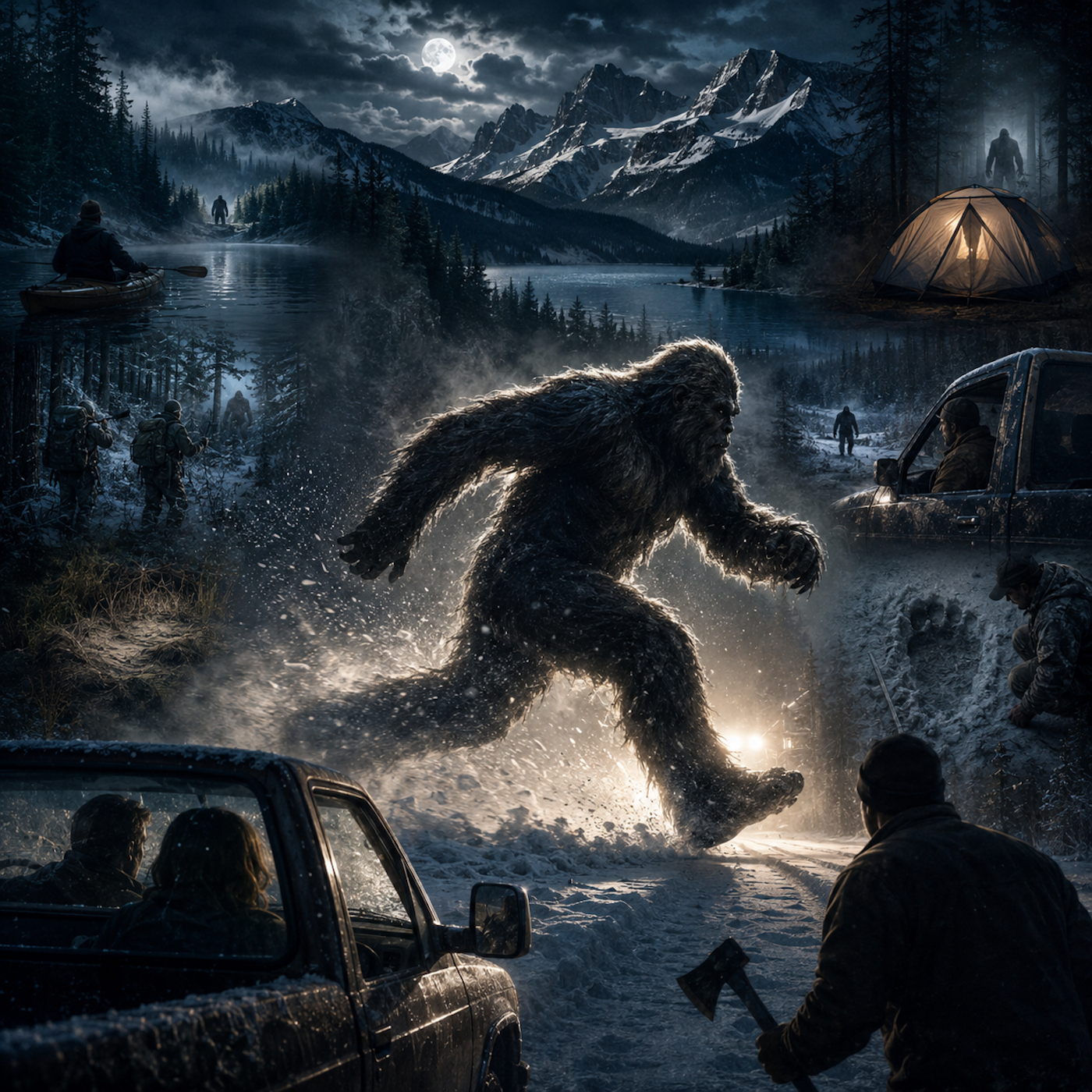
Doug and his wife were driving home from her job after dark, deep in the middle of winter, when something crossed in front of them in two strides. Not walking. Running, hunched forward the way a man runs when he's moving as hard as he can.
Doug puts it at eight feet tall and somewhere around six or seven hundred pounds, covered head to toe in dark gray hair, moving through three and a half to four feet of snow at a speed no person on snowshoes could match. He went home and got an ax and intended to go back out after it, and his wife talked him out of it, which he now concedes was the better reasoning of the two of them.
What follows is the kind of interview I like best, because Doug isn't selling anything. He was aware of the subject before it happened to him, he'd seen the Patterson-Gimlin film, and he still describes himself as somebody who simply hadn't seen it for himself yet. He talks about his great uncle Lou, a World War One veteran who worked the woods as a surveyor and spent time in the Civilian Conservation Corps camps during the Depression, and who called the thing he and his wife ran into out huckleberry picking the Skookum Man, and who got shut down by his wife Alsa before he could tell the boys any more about it.
He talks about the military survival trainer who came into his family's bar and mentioned the instruction given to men training above Cusick, Washington, near Tacoma Creek, which was not to engage bipedal creatures in the woods. He talks about why he thinks these things are seen crossing roads so often when they're otherwise almost impossible to find, why he lands on a single species rather than five or six subspecies, and why he thinks the strangeness that clings to this subject may say more about our own government than it does about the animal. He also brings the Vietnam rock ape accounts he heard from his brothers and their Marine friends, and his answer to skeptics, which is that being skeptical is perfectly fine and he isn't going to beg anybody for anything.
Partway through, I stop the interview and take a long detour, because Doug mentioned sightings up around Sullivan Lake and Priest Lake and I'd spent the previous few weeks going through the actual case files out of that country. What's on the record there is more substantial than most people realize
A woman kayaking on Sullivan Lake in August of two thousand two who floated within fifteen yards of what she first took for a very tall old man in gray, sitting on a stump with his legs crossed and his hands folded over his knee, and who learned that evening that her niece had seen the same thing from her own boat. Two fishermen four months earlier on the south end of that same lake, run out of their tent at night by crashes, a musty smell, and a gray shape seven to nine feet tall through the mesh window.
Two bear hunters northwest of Ione in September of nineteen ninety-eight who found three sets of tracks traveling together at eighteen inches, fifteen to sixteen inches, and thirteen inches, and who made a cast so poor the man freely admitted he had no idea what he was doing. A motorist outside Ione in nineteen ninety-one who stopped his car for something in the headlights and then wrote, in his own report, that he never said he saw Bigfoot, only that he saw something strange on the road and doesn't know what it was.
Then the interlude crosses the state line, because the line is a survey mark and nothing more. Priest Lake sits in Bonner County, Idaho, which carries more reports than any other county in that state, and between the two lakes is the Salmo-Priest Wilderness and the Selkirk Mountains, grizzly country, some of the least broken forest left in the lower forty-eight, running unbroken north into Canada.
Three backpackers woken at midnight in August of two thousand twenty by three loud bounces they later matched at daylight by throwing a four-foot log. A woodcutter east of Nordman in October of nineteen eighty who watched something slide down a five-foot embankment on its feet, walk alongside his moving pickup within arm's reach, look both ways before crossing in front of him, and reach a hand toward his hood, and who sat on that story for twenty-eight years. A fisherman on the Upper Priest River in two thousand sixteen, armed, who says he was too scared to move. Six hikers on Lion Creek in two thousand seventeen who found a sixteen-inch print, a pressed bed of sawgrass eight feet by nine feet, and knocks that came in threes from moving locations.
And a three-toed cast out of the Priest River country in nineteen ninety-seven that I lay out honestly as the red flag it is, along with a warning about the generated web articles now circulating around it that I could not source back to any real reporting.I close the segment on what I think actually matters in that batch, which isn't any single sighting.
It's that the woman volunteered nobody had been drinking, the hunter admitted his cast was garbage, the motorist refused to let anybody put a word in his mouth, the woodcutter reported finding no tracks, the backpackers went out and tested the sound until they matched it, and the fisherman admitted he lost track of where the thing went.
Two lakes, one mountain range, a state line that means nothing to anything living there, and thirty years of reports from bear hunters, woodcutters, kayakers, fishermen, and backpackers, most of whom kept quiet for years before they told anyone.
Email Brian
Join Our FREE Newsletter
Get Brian's Books
Leave Us A Voicemail
Visit Our Website
Bigfoot In Washington State
Previous
Previous
Born Wild: Koda's Odyssey Vol 2 Part 2
Next
Next